---
title: "MSP SEO Playbook: How MSPs Can Rank, Reach & Convert"
description: Learn how to optimize your MSP website for search. From keyword strategy to local SEO, this guide shows how to rank higher and attract qualified leads.
image: https://tacticsmarketing.com/hubfs/Featured%20Images/SEO%20Basics%20for%20MSPs.png
---
[Skip to the main content.](https://tacticsmarketing.com/blog/msp-seo#main-content)
[](https://tacticsmarketing.com)
[](https://tacticsmarketing.com)
- [How It Works](https://tacticsmarketing.com/how-it-works)
- [Pricing](https://tacticsmarketing.com/pricing)
- [Services](https://tacticsmarketing.com/services)
- [Work](https://tacticsmarketing.com/work)
- [The App](https://tacticsmarketing.com/app)
- [Who We Serve](https://tacticsmarketing.com/who-we-serve)
- [About](https://tacticsmarketing.com/about)
[](https://tacticsmarketing.com/hs/cta/wi/redirect?encryptedPayload=AVxigLKExHFj67TvEcGVYOAEA6bJdqk%2FYjp5GmUY8QgCtuQJtv5Yi5ZAVnMBrpaExPrFnV33V94dErSdtQIYzaIz4%2FZUFf7WA8M8QdNkrwK8uwFEE3bAJvyQDoVTdn7Dd2SAAakqExZAHxvTAHhbyHVFV32do%2B5%2BcxSRHlp6HY7heIZJo6yaUWEfcaZDFbz%2BEQpCHwCKecebDEPz6wQb&webInteractiveContentId=221055695537&portalId=19967070)
Toggle Menu
Toggle Menu
[](https://tacticsmarketing.com/hs/cta/wi/redirect?encryptedPayload=AVxigLKExHFj67TvEcGVYOAEA6bJdqk%2FYjp5GmUY8QgCtuQJtv5Yi5ZAVnMBrpaExPrFnV33V94dErSdtQIYzaIz4%2FZUFf7WA8M8QdNkrwK8uwFEE3bAJvyQDoVTdn7Dd2SAAakqExZAHxvTAHhbyHVFV32do%2B5%2BcxSRHlp6HY7heIZJo6yaUWEfcaZDFbz%2BEQpCHwCKecebDEPz6wQb&webInteractiveContentId=221055695537&portalId=19967070)
- [How It Works](https://tacticsmarketing.com/how-it-works)
- [Pricing](https://tacticsmarketing.com/pricing)
- [Services](https://tacticsmarketing.com/services)
- [Work](https://tacticsmarketing.com/work)
- [The App](https://tacticsmarketing.com/app)
- [Who We Serve](https://tacticsmarketing.com/who-we-serve)
- [About](https://tacticsmarketing.com/about)
[Facebook](https://www.facebook.com/tacticsmkt) [Instagram](https://www.instagram.com/tacticsmkt) [Linkedin](https://www.linkedin.com/company/tacticsmarketing) [YouTube](https://www.youtube.com/@TacticsMkt)
6 min read
# MSP SEO Guide: Everything MSPs Need to Know Before Ranking on Google
[ Matt](https://tacticsmarketing.com/blog/author/matt) : Published December 23, 2025 Updated June 2, 2026
[SEO & Local Search](https://tacticsmarketing.com/blog/tag/seo-local-search)
Effective MSP SEO helps managed service providers rank higher on Google, attract qualified local leads, and build long-term credibility. By focusing on E-E-A-T, technical optimization, targeted keywords, and local SEO, MSPs can turn search visibility into consistent client growth.
When a prospect searches “IT support near me” or “managed services \[in city\]”, Google decides who gets seen. And that decision? It’s built on SEO.
MSP SEO is all about showing Google (and potential clients) that you’re credible, relevant, and trustworthy. Sure, you may not rank high on Google overnight. But employ the right SEO strategy, and your MSP will get there eventually.
This guide covers the key MSP SEO elements that every business needs to master to rank on Google.
## Why MSP SEO Matters
Most MSPs still rely on referrals or cold outreach. But your next client, be it an IT manager or small-business owner, isn’t waiting for a call. They’re Googling. And the MSP that shows up first often wins the deal.
That’s what MSP SEO does. It puts your business where your buyers are already looking. Here’s why it matters:
- **Builds instant credibility:** Ranking on Google signals you’re established, capable, and trusted
- **Drives qualified leads:** SEO attracts businesses actively searching for managed IT help, not casual browsers
- **Delivers long-term ROI:** On average, every [$1 spent on SEO delivers a return of $22](https://explodingtopics.com/blog/seo-statistics) in the long run
- **Gives a local edge:** Local SEO helps you dominate searches like “managed IT services in Austin” or “MSP in Seattle”
## The Foundations of MSP SEO: E-E-A-T + Technical SEO
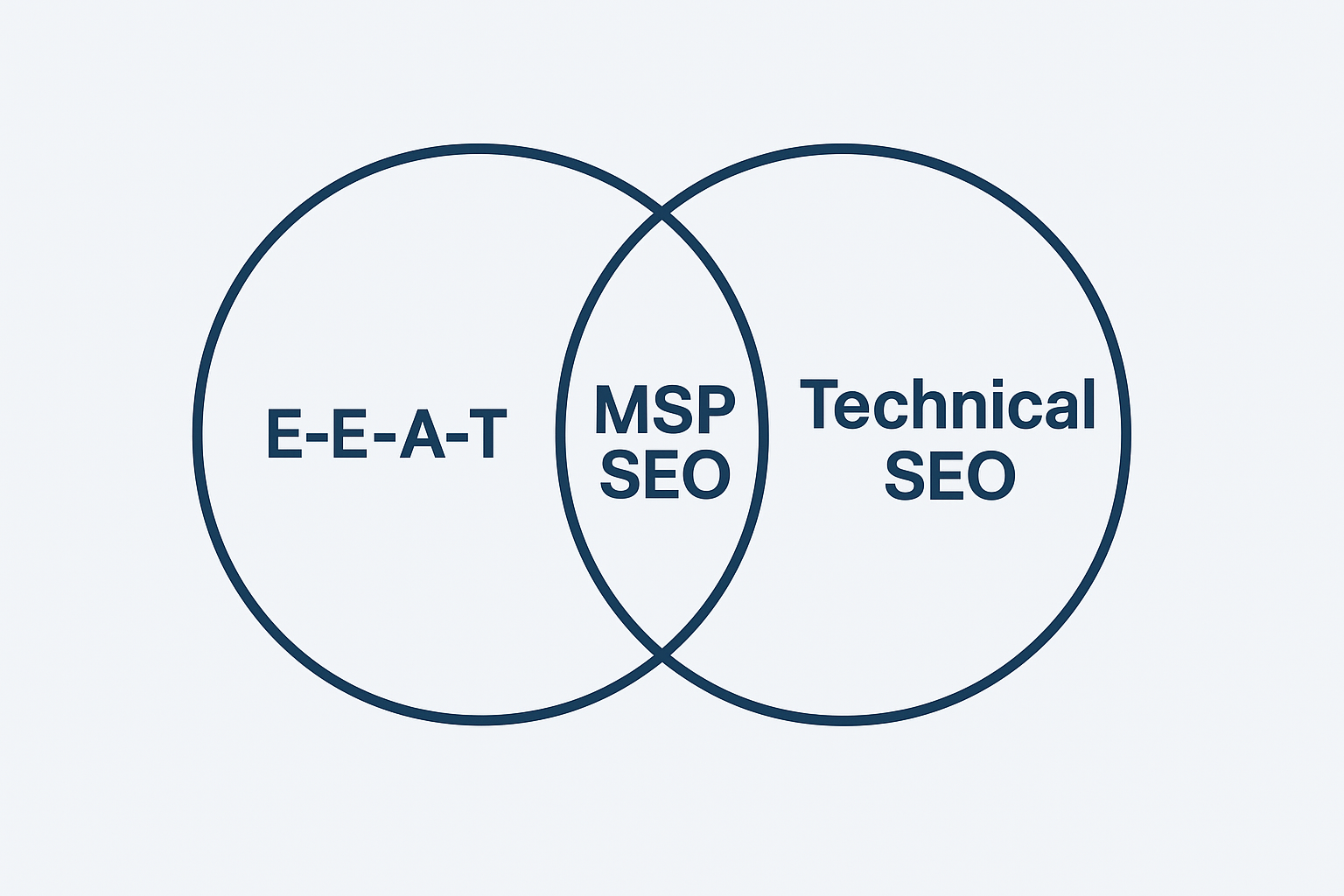
Before scaling visibility, you need a strong base. Google rewards MSPs that demonstrate trust, expertise, and performance. This is where E-E-A-T and technical SEO come in.
### E-E-A-T: Building trust the Google way
E-E-A-T (Experience, Expertise, Authoritativeness, and Trustworthiness) is Google’s quality compass. For MSPs, it’s the difference between being seen as a vendor or a verified expert handling critical IT systems.
Here are some strategies to strengthen E-E-A-T:
- **Show your wins:** Share case studies and client success stories that prove you can deliver
- **Flex your credentials:** Flaunt certifications like Microsoft Partner or CompTIA as they scream credibility
- **Differentiate in your niche:** Publish blogs, whitepapers, and webinars that show you know the MSP game
- **Offer trust and transparency:** Use HTTPS, list real contact details, and reply to reviews like a pro
E-E-A-T develops a credible digital footprint that improves your chances of ranking and converting.
### Technical SEO: The backbone of MSP website optimization
Your site structure props great content. Lay this foundation on technical soundness. This ensures Google can crawl, index, and reward your MSP website.
For that, you need to focus on these essentials:
- **Speed matters:** No one waits around for slow pages. A mere one-second delay can [cut down sales by 20%](https://www.okoone.com/spark/product-design-research/how-slow-websites-lose-customers-and-revenue-every-day/). So, compress, cache, and cut the bloat
- **Think mobile-first:** About [64% of searches](https://explodingtopics.com/blog/mobile-internet-traffic) start on phones, not desktops. Design like it
- **Keep it clean:** Menus, URLs, and internal links should make sense to humans and Google
- **Stay secure:** HTTPS isn’t optional; it’s the trust badge every visitor expects "If you're not doing this, you need to reevaluate your life as a tech"
- **Use schema magic:** Add service and FAQ markup so Google knows exactly what you offer
These are the non-negotiables that make your MSP site both discoverable and dependable.
## What Are the Core Fundamentals of an MSP SEO Strategy
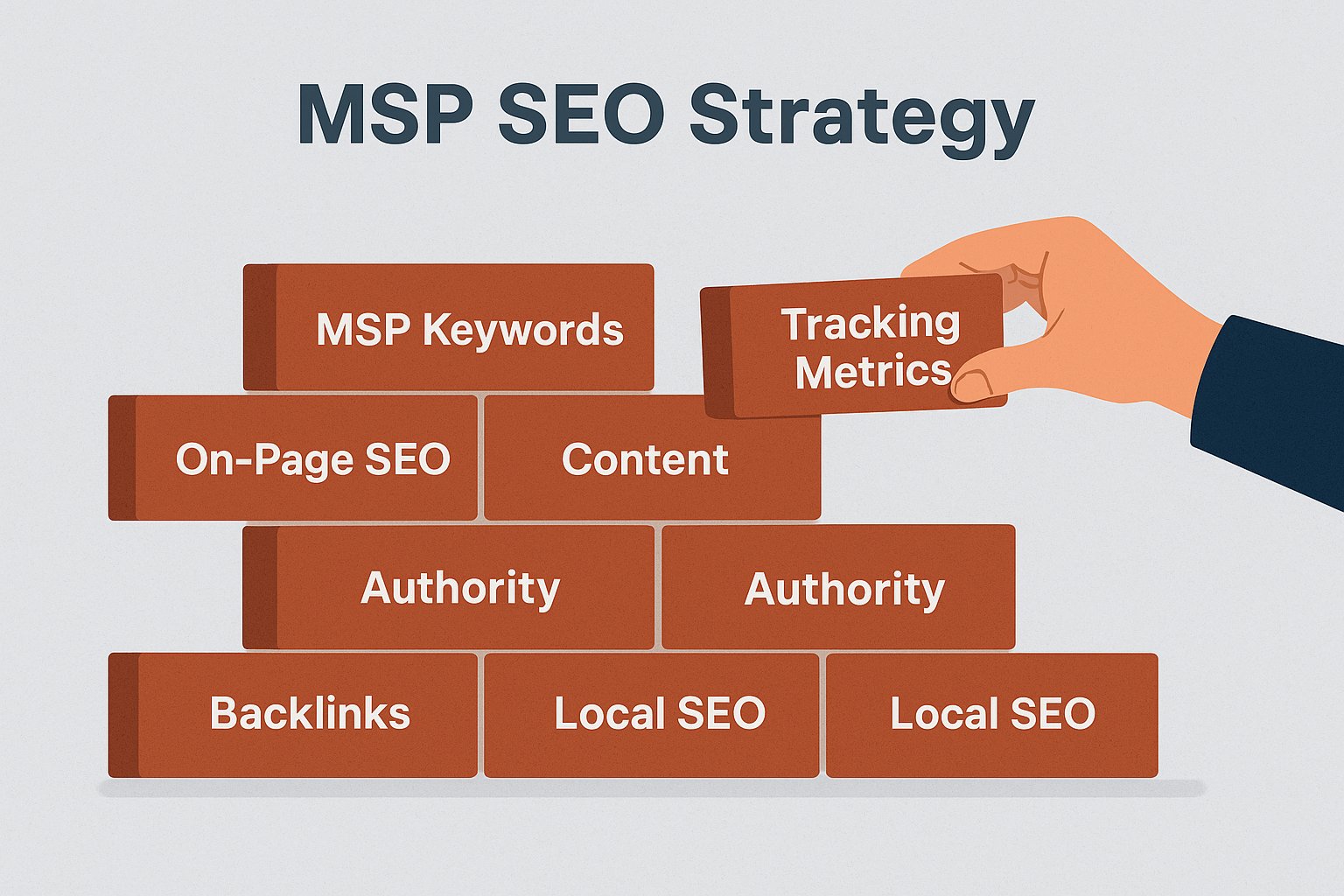
Let’s move from theory to action. Here are the practical building blocks of MSP SEO services that promise to drive visibility, traffic, and leads.
### Keyword strategy for MSPs
Keywords are the compass of every MSP SEO effort. They determine who finds you, what intent they have, and whether that visit turns into a conversation or conversion. For MSPs, precision matters more than popularity.
Here’s how to build a keyword strategy that delivers:
- Focus on MSP-specific terms. Ditch broad IT phrases like “tech support.” Target focused, high-value searches such as MSP services, managed IT provider, IT helpdesk in \[city\], or cybersecurity for SMBs
- Use keyword intent to guide content. Awareness-stage phrases (“what is managed IT”) attract researchers. Decision-stage ones (“MSP near me,” “MSP SEO services”) convert ready buyers
- Map keywords to purpose-built pages. Assign service-focused terms to core pages and broader, educational terms to blogs. It helps Google understand your site’s structure while also mapping out the visitor’s journey
- Prioritize relevance over volume. A niche keyword that perfectly fits your offering beats a high-volume, generic one every time
- Refresh quarterly. Update your keyword list every few months. Add new phrases as technology trends shift. Think AI-powered IT management or cloud MSP solutions
### On-page and content strategies
This is where MSP website optimization comes to life. Strategic on-page SEO ensures Google (and potential clients) quickly understand what you offer. It delivers clarity, relevance, and authority.
Check out these actionable steps to optimize your content:
- Polish your on-page essentials. Optimize title tags, meta descriptions, and headers with natural keyword placement. Keep it human, clear, and relevant
- Build internal links with intent. Link related pages (e.g., from “Managed IT Services” to “Cloud Backup Solutions”) to help users and Google discover your expertise
- Create topic clusters. Develop a pillar page for a broad topic (like Managed IT Services) and connect supporting blogs, such as Cybersecurity for SMBs or Disaster Recovery Planning
- Diversify content types. Mix blogs with videos, case studies, and infographics. It improves engagement and time-on-site
- Keep content evergreen. Update older posts with new stats, examples, and insights. Google rewards freshness
- Add schema markup. Use the Service and FAQ schema to enhance visibility with rich snippets and improved SERP presentation
### Off-page and authority building
Your on-page work gets you noticed. Off-page SEO earns you trust. For MSP SEO services, authority is built through what others say about you, not just what you say yourself.
Here’s how to strengthen your authority footprint:
- Earn quality backlinks. Target partnerships with tech blogs, vendors, and industry publications. Avoid cheap link networks that damage credibility
- Leverage collaborations. Co-author blogs, share webinars, or publish joint case studies with technology partners. Mutual visibility builds mutual trust
- List your business consistently. Maintain identical Name, Address, and Phone (NAP) data across reputable directories like [Clutch](https://clutch.co/), [UpCity](https://upcity.com/lists), and local chambers
- Generate PR momentum. Pitch client success stories to local outlets or trade publications. Local press adds relevance and authority
- Encourage and respond to reviews. Ask happy clients to review you on Google and niche MSP directories. Reply to every review. It shows transparency and professionalism
- Show social proof. Display certifications, testimonials, and partner logos across your site. Visual trust cues matter as much as words
### Local and geo-targeted SEO
Most MSPs thrive on local business. That’s why local SEO for MSP is more than just an add-on; it’s a growth driver. Google’s Map Pack dominates local intent searches, and that’s where you need to be.
Some key actions to win locally are:
- Understand why GEO drives growth. Appearing in local searches means showing up where real prospects are looking, such as maps, directories, and “near me” results
- Optimize your Google Business Profile. Complete every field, upload real photos, post updates, and highlight services. Regular activity boosts visibility
- Create city or service-area pages. Build dedicated pages like MSP in Dallas or Managed IT Support in Austin. Include local testimonials and references
- Secure local citations. Keep consistent NAP details across Google, Bing, Yelp, and local IT directories. Consistency builds credibility
- Publish localized content. Create region-specific blogs, such as "How Houston SMBs Can Strengthen Cybersecurity Before Hurricane Season"
- Blend local SEO with broader SEO. Local SEO helps you win the map pack; general SEO keeps you ranking nationwide. A balanced MSP SEO strategy needs both
### Set realistic expectations
SEO isn’t instant. It’s incremental. Success builds over time, but every improvement compounds.
Here’s what realistic progress looks like:
- **0–3 months**: Site audit, fixes, keyword targeting, and content foundation. Expect early ranking signals
- **3–6 months**: Steady traffic growth and improved visibility in local searches. First conversions start to show
- **6–12 months**: Strong keyword positions, consistent leads, and established domain authority
### Track metrics that matter
Track the right indicators, not vanity numbers. Your goal isn’t just traffic—it’s qualified, converting traffic.
Monitor:
- Organic sessions and impressions (overall visibility)
- Keyword rankings for your target MSP SEO terms
- Click-through rates (CTR) from search results
- Conversions (form fills, calls, demo requests)
- Local metrics (map impressions, GBP interactions)
Tools like [Google Search Console](https://search.google.com/search-console/about), [Google Analytics](https://marketingplatform.google.com/about/analytics/), and [BrightLocal](https://www.brightlocal.com/) make this easy to track. Once you see what’s working, double down. If a city page or blog drives leads, expand on it. That’s how SEO becomes a growth engine.
## Key Takeaways
- MSP SEO builds trust, visibility, and long-term growth
- Strengthen your foundation with E-E-A-T and strong technical SEO
- Focus on intent-based and local keywords
- Create valuable, easy-to-read content
- Earn backlinks and reviews to boost authority
- Don’t forget local SEO for MSP, considering geography drives growth
- Track results and stay consistent. Remember, patience pays off
## Visibility Today, Credibility Tomorrow: The SEO Payoff for MSPs
Ranking on Google isn’t about tricking algorithms, it’s about proving your expertise. For MSPs, SEO is more than a marketing tactic; it’s how you earn visibility, credibility, and client trust.
At [Tactics Marketing](https://tacticsmarketing.com/), we help MSPs turn SEO into a steady lead engine: one that works 24/7 to bring qualified prospects your way.
If you’re ready to rank higher and grow smarter, [book a call](https://tacticsmsp.com/meetings/matt-middlestetter/quickchat?hsLang=en-us&uuid=ce7eb1c3-54a0-450b-a3b7-d21a366b5d63) with us now and let’s make it happen.
## FAQs
1\. Can I just buy my way to #1?
Paid ads can boost visibility quickly. That said, this traffic stops once you stop paying. SEO builds sustainable, long-term growth.
---
2\. What is the real value of SEO?
SEO attracts clients who are actively looking for your services. It builds credibility, lowers acquisition costs, and scales your reach organically.
---
3\. How are local SEO and SERP different?
Local SEO focuses on improving visibility in your geographic area, like Google Maps or “near me” searches. SERP (Search Engine Results Page) rankings reflect your position in overall organic results, both local and national.
[](https://tacticsmarketing.com/blog/the-cybersecurity-seo-trap-why-your-msp-marketing-fails-when-you-speak-vendor-instead-of-client)
#### [The Cybersecurity SEO Trap: Why Your MSP Marketing Fails When You Speak Vendor Instead of Client](https://tacticsmarketing.com/blog/the-cybersecurity-seo-trap-why-your-msp-marketing-fails-when-you-speak-vendor-instead-of-client)
[ Matt](https://tacticsmarketing.com/blog/author/matt) : Feb 4, 2026, 4:28:13 AM
Stop competing with software giants. Discover how to shift from vendor-level keywords to problem-solution SEO that drives real leads for your MSP.
[SEO & Local Search](https://tacticsmarketing.com/blog/tag/seo-local-search)
[Read More](https://tacticsmarketing.com/blog/the-cybersecurity-seo-trap-why-your-msp-marketing-fails-when-you-speak-vendor-instead-of-client)
[](https://tacticsmarketing.com/blog/fix-your-visibility-the-msp-guide-to-nap-consistency)
#### [Fix Your Visibility: The MSP Guide to NAP Consistency](https://tacticsmarketing.com/blog/fix-your-visibility-the-msp-guide-to-nap-consistency)
[ Monica](https://tacticsmarketing.com/blog/author/monica) : May 5, 2026, 10:00:00 AM
Stop losing leads to competitors. Discover how fixing your MSP's NAP consistency and local citations can dramatically improve your local search...
[SEO & Local Search](https://tacticsmarketing.com/blog/tag/seo-local-search)
[Read More](https://tacticsmarketing.com/blog/fix-your-visibility-the-msp-guide-to-nap-consistency)
[](https://tacticsmarketing.com/blog/youre-not-losing-leads-to-better-msps-youre-losing-on-local-searches)
#### [You’re Not Losing Leads to Better MSPs…You’re Losing On Local Searches](https://tacticsmarketing.com/blog/youre-not-losing-leads-to-better-msps-youre-losing-on-local-searches)
[ Matt](https://tacticsmarketing.com/blog/author/matt) : May 1, 2026, 1:00:00 PM
Stop losing local contracts to competitors. Learn how MSPs can rule local SEO, optimize their Google Business Profile, and capture high-intent IT...
[Lead Generation](https://tacticsmarketing.com/blog/tag/lead-generation) [SEO & Local Search](https://tacticsmarketing.com/blog/tag/seo-local-search)
[Read More](https://tacticsmarketing.com/blog/youre-not-losing-leads-to-better-msps-youre-losing-on-local-searches)
- [Plans & Pricing](https://tacticsmarketing.com/pricing)
- [Additional Items](https://tacticsmarketing.com/services)
- [The Signal](https://mspsignal.com)
- [Our Work](https://tacticsmarketing.com/work)
- [Free Analysis + Tee](https://tacticsmarketing.com/get-your-free-analysis-tee)
- [Blog](https://tacticsmarketing.com/blog)
- [Resources](https://tacticsmarketing.com/resources)
Tactics Marketing, Middlestetter, LLC · Bend, Oregon.
HubSpot Gold Partner. Marketing for MSPs, cloud providers, and IT service companies — from $1M single-market shops to $20M+ regional and national operators.
Owner level advisory is Matt's separate practice → [middlestetter.com](http://middlestetter.com)
Tactics Marketing
750 Barclay Lane
Sisters, OR 97759
[541-444-3626](tel:5414442626)
[info@tacticsmarketing.com](mailto:info@tacticsmarketing.com)
[](https://tacticsmarketing.com)
- [Terms and Conditions](https://tacticsmarketing.com/terms-and-conditions)
- [Privacy Policy](https://tacticsmarketing.com/privacy-policy)
- [Do Not Sell or Share My Personal Information](https://na1.hs-data-privacy.com/request/ssU8x0NV74ieOF6w2BFt5Q)
© 2026 Middlestetter, LLC DBA Tactics Marketing
[Facebook](https://www.facebook.com/tacticsmkt)[Instagram](https://www.instagram.com/tacticsmkt)[Linkedin](https://www.linkedin.com/company/tacticsmarketing)[YouTube](https://www.youtube.com/@TacticsMkt)
Return to top
```json
{
"@context" : "https://schema.org",
"@type" : "BlogPosting",
"author" : {
"@type" : "Person",
"name" : "Matt",
"url" : "https://tacticsmarketing.com/blog/author/matt"
},
"dateModified" : "2026-03-03T22:07:30.415Z",
"datePublished" : "2025-12-23T22:00:01.000Z",
"headline" : "MSP SEO Playbook: How MSPs Can Rank, Reach & Convert",
"image" : [ "https://tacticsmarketing.com/hubfs/Featured%20Images/SEO%20Basics%20for%20MSPs.png" ],
"mainEntityOfPage" : {
"@id" : "https://tacticsmarketing.com/blog/msp-seo",
"@type" : "WebPage"
},
"publisher" : {
"@type" : "Organization",
"logo" : {
"@type" : "ImageObject",
"url" : "https://tacticsmarketing.com/hubfs/Tactics%20Branding%202025/Tactics%20white%20logo.png"
},
"name" : "Tactics Marketing"
}
}
```
```json
{
"@context" : "https://schema.org",
"@type" : "BreadcrumbList",
"itemListElement" : [ {
"@type" : "ListItem",
"item" : "https://tacticsmarketing.com",
"name" : "Home",
"position" : 1
}, {
"@type" : "ListItem",
"item" : "https://tacticsmarketing.com/blog",
"name" : "Blog",
"position" : 2
}, {
"@type" : "ListItem",
"item" : "https://tacticsmarketing.com/blog/msp-seo",
"name" : "MSP SEO Guide: Everything MSPs Need to Know Before Ranking on Google",
"position" : 3
} ]
}
```
```json
{
"@context" : "https://schema.org",
"@type" : "BlogPosting",
"author" : [ {
"@type" : "Person",
"name" : "Matt",
"url" : "https://tacticsmarketing.com/blog/author/matt"
} ],
"dateModified" : "2026-06-02T23:00:09Z",
"datePublished" : "2025-12-23T22:00:01Z",
"description" : "Learn how to optimize your MSP website for search. From keyword strategy to local SEO, this guide shows how to rank higher and attract qualified leads.",
"headline" : "MSP SEO Guide: Everything MSPs Need to Know Before Ranking on Google",
"image" : [ "https://19967070.fs1.hubspotusercontent-na1.net/hubfs/19967070/Featured%20Images/SEO%20Basics%20for%20MSPs.png" ],
"inLanguage" : "en",
"keywords" : "SEO & Local Search",
"mainEntityOfPage" : {
"@id" : "https://tacticsmarketing.com/blog/msp-seo",
"@type" : "WebPage"
},
"publisher" : {
"@type" : "Organization",
"name" : "Middlestetter LLC | DBA Tactics Marketing"
}
}
```