MSP Marketing Strategy Business Continuity

Three Tiers Walk Into a Sales Call. Only One of Them Closes

Monica
Monica Aug 6, 2026, 4:00:00 PM 8 min read
Three Tiers Walk Into a Sales Call. Only One of Them Closes

Three tiers, built right, do the selling before you ever get on a call. Here's how to design MSP service tiers that actually convert.

TL;DR: Tiered pricing sounds simple until you realize most MSPs built their tiers backward, starting with what they deliver instead of how buyers decide. When a prospect stares at three packages and can't figure out which one fits, they don't ask for help. They either pick the cheapest option or leave. The middle tier is the one that does the most work in a well-built structure, but it only works if it was designed to. When tiers are built around how buyers actually make decisions, the right client picks the right package and the price conversation mostly takes care of itself.


Most MSPs have three service tiers. Essential, Professional, Enterprise. Or some variation of that. The names change but the structure is usually the same: a cheap option, a middle option, and a premium option that mostly exists to make the middle one look reasonable. The problem isn't the concept.


It's that most of those tiers were built around what's easy to deliver, not around how a buyer actually makes a decision. Those are very different design problems, and only one of them produces a package that sells.

Think about the last time you bought a phone plan. You didn't read every line of every tier. You looked at the middle one, decided it seemed reasonable, and moved on. That's not laziness. That's how people make decisions when the options are clear and the differences are obvious. When they're not, people stall, pick the cheapest option, or go find a provider whose packages make more sense. The prospect who leaves your pricing page confused isn't coming back to ask for clarification.

That dynamic matters right now because the MSP market is more crowded than it's ever been. Prospects are evaluating multiple providers at once, often without a technical background to guide them. Most of them won't tell you your tiers are confusing. They'll just go somewhere else. Your tier structure is doing sales work before you ever get on a call, and most MSPs have no idea whether it's working for them or against them.

Packaging is positioning. How you structure your tiers signals your confidence, your understanding of your clients, and whether you've thought carefully about what they actually need. This post is about building tiers that do the selling for you.

Table of Contents

  1. Why Three Tiers (Not Two, Not Four)
  2. The Psychology Behind the Middle Tier
  3. What Belongs in Each Tier
  4. Naming, Framing, and Presenting Your Tiers
  5. Common Tier-Building Mistakes
  6. When to Revisit Your Tier Structure
  7. When the Packaging Is Right, the Close Takes Care of Itself
  8. Key Takeaways
  9. Frequently Asked Questions

Why Three Tiers (Not Two, Not Four)

The number three is not arbitrary. It's the minimum needed to create a meaningful middle option, and it's the maximum most buyers can evaluate without hitting decision fatigue.

Two tiers feel like a binary: cheap or expensive, basic or premium. Buyers who land in the middle (which is most buyers) have nowhere comfortable to go, so they either negotiate down or stall. Four or more tiers create a comparison problem. Prospects start asking what the difference is between tiers two and three, and suddenly, you're in a feature negotiation instead of a value conversation.

Three tiers work because they tap into fundamental human psychology. Many customers are guided by the Goldilocks Principle, instinctively avoiding extremes and gravitating toward the middle option because it feels "just right." The premium tier acts as a price anchor, making the middle tier seem like a compelling value by comparison, a phenomenon known as the decoy effect.

In practical terms: if you want most prospects to land in your bread-and-butter tier (and you do, because that's where your margins live), you need a premium option above it to make it feel like the smart choice. Three tiers give you that. Two and four don't.

The Psychology Behind the Middle Tier

The middle tier is doing most of the work in your pricing structure, so it deserves the most attention at the design stage. Not the most services, the most thought.

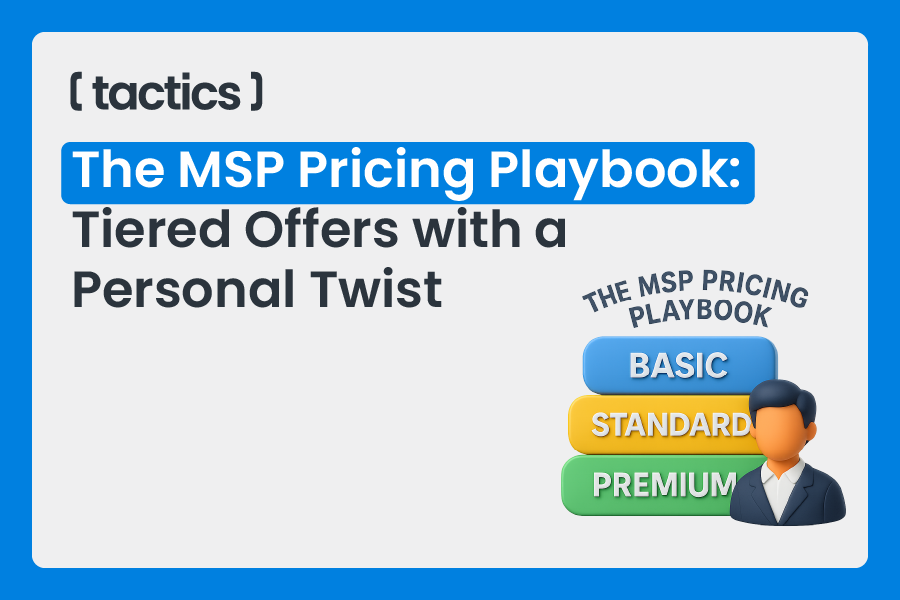
Your "Good" tier gets clients in the door by solving a core problem. Your "Best" tier provides a premium experience that justifies the value of the other two. But the "Better" tier is the one that should offer the ideal solution for most of your market, which means it needs to be genuinely compelling on its own merits, not just a halfway point between cheap and expensive. It should include everything a typical quality client actually needs: solid security coverage, responsive support, tested backups, and enough strategic thinking to give the relationship real longevity. If a prospect looked at only your middle tier and never saw the others, they should still feel like they're getting a real deal.

The entry tier's job is to be accessible without being a liability. If it's missing critical security components, you're not offering a budget option; you're offering a gap that will eventually hurt both your client and your reputation. Security essentials belong in every tier, full stop.

The premium tier's job is to justify its existence and make the middle tier look reasonable by comparison. Compliance work, dedicated account management, quarterly business reviews, vCIO planning: services that have real value for the right clients, without being so loaded that nobody can afford it.

What Belongs in Each Tier

Here's a practical framework for what lives where, using the Essential/Professional/Enterprise model as a reference point. The names are less important than the logic behind them: each tier should represent a meaningfully different level of coverage, not just a different price point with a few features swapped in or out.

Essential (Entry Tier)
The floor. Covers the non-negotiables: 24/7 remote monitoring, help desk with a written SLA, automated patch management, EDR (not basic antivirus), backup monitoring with tested restores, and MFA enforcement. This tier is for price-sensitive clients who need the basics covered without compromise on security. It's not a stripped-down offering; it's a focused one.

Professional (Middle Tier)
Everything in Essential, plus email security, after-hours support, more robust backup (cloud or hybrid), and basic quarterly check-ins. This is where most quality small business clients naturally land, and the tier should be designed for them specifically, not as an afterthought. It should feel like the obvious fit for a 20–75 person company that takes its technology seriously.

Enterprise (Premium Tier)
Everything in Professional, plus compliance support, dedicated account management, formal vCIO planning sessions, and quarterly business reviews. Built for regulated industries, security-conscious clients, or businesses that want a genuine strategic IT partner rather than just a support desk.

If you want to see this framework applied with specific price points attached, Your MSP Pricing Is Either Building Your Business or Bleeding It walks through a practical example that's worth bookmarking before you sit down to build your own tiers.

Naming, Framing, and Presenting Your Tiers

The names you choose matter more than most MSPs realize. Bronze/Silver/Gold sounds like a rewards program at a car wash. Essential/Professional/Enterprise (or whatever language fits your brand) sounds like deliberate service design. Names should communicate the client profile, not a metal hierarchy.

When you present tiers, sequence matters. Lead with the premium tier first. Let prospects see the full picture before they anchor on the lowest number. Then walk down. By the time you get to the middle tier, it feels like a bargain relative to what they just saw, even if it's the exact price you had in mind all along.

Presenting choices this way reduces decision paralysis and often helps clients land on a tier that genuinely fits their needs, rather than defaulting to the cheapest option out of uncertainty.

One more presentation principle: show the tiers side by side whenever possible. A comparison table or simple visual lets prospects see exactly what they're getting and what they're giving up at each level. That visual clarity moves the conversation from "can I afford this?" to "which one fits us?"

Common Tier-Building Mistakes

A few patterns show up consistently in tier structures that aren't converting. They're worth knowing before you build, not after.

Leaving security out of the entry tier. This is the most common mistake and the most dangerous. Fixed pricing that strips critical services from lower tiers creates gaps that show up at exactly the wrong moment, and clients who get breached on your watch because they were on a cheap plan aren't going to remember that the plan was their choice. EDR and tested backups belong in every tier, full stop.

Making the tiers too similar. If the difference between Essential and Professional is two features and $15, prospects won't upgrade. The jump between tiers should be meaningful enough to be worth the conversation.

Too much overlap in the premium tier. If your Enterprise tier is just your Professional tier with one extra quarterly meeting, clients will correctly identify it as overpriced. Premium tiers need premium value: compliance work, dedicated contacts, strategic planning that saves clients real money or real headaches.

Pricing the tiers too close together. The spread between tiers should reflect the value difference. If Essential is $110, Professional should probably be $145–$160, not $120. Thin spreads signal that the tiers are arbitrary.

When to Revisit Your Tier Structure 

Tiers are not set-and-forget. At a minimum, revisit your tier contents and pricing once a year. More specifically, whenever your tooling costs go up, whenever you add a new service category, or whenever you notice too many clients landing in your entry tier. That last one is a signal worth paying attention to. It usually means either the entry tier is too good or the middle tier isn't compelling enough.

A tier structure that made sense in 2022 may be leaving margin on the table in 2026. Security tooling has gotten more expensive. Compliance requirements have expanded. If your Professional tier hasn't evolved to reflect that, you're delivering more value than you're charging for.

When the Packaging Is Right, the Close Takes Care of Itself

Tiered pricing isn't complicated in theory. Three options, clear differences, and a middle tier that most clients naturally land on. What makes it hard is that most MSPs build their tiers from the inside out, starting with what's easy to deliver instead of what's easy to buy. The sections above flip that around.

Most prospects don't struggle to afford a good MSP. They struggle to choose one when the options all look the same, or none of them seem to fit. A tier structure with real separation, intentional naming, and a middle tier built for the client you actually want is the fix for that. It doesn't close every deal, but it stops losing the ones that should have been easy.

Tactics works exclusively with MSPs, which means packaging problems aren't abstract here. They show up in the actual conversations we have with owners who are great at delivering IT and less sure about how to present it. Pricing structure and marketing positioning are more connected than most owners realize: how you package your services shapes how prospects perceive your value before they ever get on a call with you.

If your tiers are doing more confusing than converting, let's fix that. Get in touch with Tactics Marketing and let's make sure your packaging reflects what you're actually worth. How known do you want to be? Get Findable.

Key Takeaways

  • Three tiers is the right number. Two creates a binary; four or more creates paralysis. Three gives prospects a comfortable middle to land on.
  • The middle tier does the heaviest lifting. Design it for the clients you actually want, not as a compromise between the other two.
  • Security essentials belong in every tier. Stripping EDR and testing backups from the entry tier creates risk for your clients and liability for you.
  • Name tiers to reflect client profiles, not a metal hierarchy. The names you choose signal whether your packaging was designed with intention.
  • Revisit your tier structure at least annually. Your costs are going up; your tiers should reflect that.
  • Leading with the premium tier in a sales presentation makes the middle tier feel like the obvious, well-priced choice.

Frequently Asked Questions

1. Should every client be on a tier, or can I still do custom quotes?
Tiers should be your default for most clients. Custom quotes are appropriate for large, complex, or unusual environments where no tier fits cleanly. But if custom quotes are becoming your standard process, that's a signal your tiers aren't covering your typical client well. Fix the tiers first.

2. How do I handle clients who want services from different tiers?
Build an add-on menu for services that don't fit neatly into any tier: specific compliance work, extra locations, vCIO hours beyond what's included. Tiers cover the standard service stack; add-ons handle the exceptions. This keeps your billing clean while giving you flexibility without blowing up the tier structure.

3. What if a prospect says my tiers are too expensive?
That's either a positioning problem or a prospect problem. If you've built your tiers based on real costs and real margins, the number is right. The conversation then becomes about value: what does downtime actually cost them, what would a breach cost them, what does a junior IT hire actually cost them, fully loaded? If they still won't move, they may not be the right client. An MSP full of clients who won at the price negotiation is not a business you want to run.

Don't forget to share this post!